- Automated session management
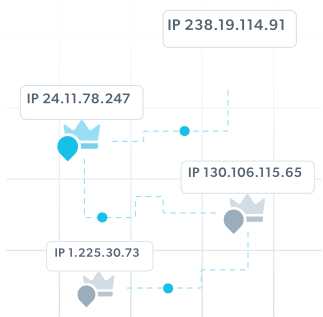
- Target any city in 195 countries
- Unlimited concurrent sessions
Recurrent Neural Network (RNN)
TLDR: A recurrent neural network (RNN) is a neural network for sequential data. It keeps a memory of previous inputs to understand context and order.
A recurrent neural network (RNN) processes data one step at a time. It maintains a hidden state — a memory of what came before. This lets it model order and context across a sequence. RNNs handle text, speech, and time-series data. They were the standard for natural language processing before transformers. An RNN is a neural network with a feedback loop.
How an RNN Works
- Sequential Processing: The network reads one element of the sequence at a time.
- Hidden State: A memory vector carries information forward to the next step.
- Shared Weights: The same parameters apply at every time step.
- Backpropagation Through Time: Training unrolls the sequence and updates weights across it.
RNN Variants
- LSTM (Long Short-Term Memory): Gates control what to keep or forget. This handles long sequences far better.
- GRU (Gated Recurrent Unit): A lighter, faster alternative to the LSTM.
- Bidirectional RNN: Reads the sequence forward and backward for richer context.
The Vanishing Gradient Problem
Basic RNNs struggle to learn long-range dependencies. Gradients shrink as they propagate back through many steps. Early inputs stop influencing the output. LSTM and GRU gates were invented to fix this. They let useful signals persist across long sequences.
What RNNs Are Used For
- Language Modeling: Predicting the next word to generate text. A building block of generative AI.
- Machine Translation: Mapping a sentence from one language to another.
- Speech Recognition: Converting audio sequences into text.
- Time-Series Forecasting: Predicting demand, prices, or sensor readings.
- Sentiment Analysis: Classifying the tone of a text sequence. See sentiment analysis.
RNN vs CNN vs Transformer
RNNs process data sequentially and keep a memory. CNNs process spatial data like images in parallel. Transformers replaced RNNs for most NLP tasks. They use attention to read a whole sequence at once. This makes them faster to train and better at long context. Modern large language models are transformers, not RNNs.
Training RNNs with the Right Data
RNNs need large, well-structured sequential datasets. Text corpora and clean time series drive their accuracy. Quality training data matters more than model size. Bright Data’s Web Scraper collects real-world text and time-series data. Its datasets deliver structured, model-ready sequences at scale.
전 세계 20,000+ 고객이 신뢰하는 서비스


Welcome to the Scraping Cloud