- Automated session management
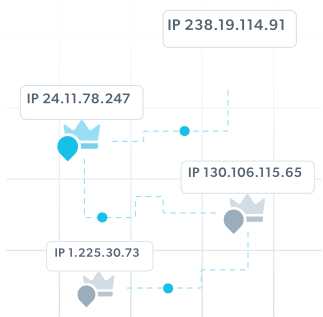
- Target any city in 195 countries
- Unlimited concurrent sessions
Attention Mechanism
TLDR: An attention mechanism lets a model weigh which parts of the input matter most. It is the core idea behind transformers and modern large language models.
An attention mechanism lets a model focus on the most relevant parts of its input. It does not treat every token equally. Instead it assigns each one a weight. A higher weight means more influence on the output. Attention powers the transformer architecture. That architecture underlies today’s large language models. It solved the long-range context problem that limited recurrent neural networks.
How Attention Works
- Query, Key, Value: Each token is projected into three vectors.
- Scores: The query compares against every key to score relevance.
- Softmax Weights: Scores become weights that sum to one.
- Weighted Sum: Values combine by weight into a context vector.
- Output: The context vector feeds the next layer.
Self-Attention vs Cross-Attention
- Self-Attention: Tokens attend to other tokens in the same sequence.
- Cross-Attention: Tokens in one sequence attend to another, as in translation.
- Multi-Head Attention: Several attention layers run in parallel. Each captures a different type of relationship.
Why Attention Replaced RNNs
RNNs read a sequence one step at a time. Long sequences lost their earliest context. Attention reads the whole sequence at once. It runs in parallel, so training is far faster. And it captures long-range dependencies directly. This is why transformers replaced RNNs for natural language processing.
Attention in Large Language Models
Transformers stack many attention layers. Each layer refines which tokens matter for the next. This is how a model tracks context across thousands of words. Attention is the engine behind generative AI systems. Weak attention over long context is one cause of AI hallucination.
Training Attention Models with the Right Data
Attention-based models need huge, high-quality text corpora. Their accuracy depends on the breadth of that training data. Bright Data’s Web Scraper collects real-world text at scale. Its datasets deliver clean, structured data for training. And the Web MCP server grounds models in live web data at inference time.
전 세계 20,000+ 고객이 신뢰하는 서비스


Welcome to the Scraping Cloud